
351 Gees Mill Business Pky N, Conyers, GA 30013
Available 24/7
351 Gees Mill Business Pky N, Conyers, GA 30013
Available 24/7
When a drip will not quit, a tank runs cold, or a shutoff hides in a slab house, Conyers Plumbing Co answers plumbing questions in Conyers, GA for the people who live there. We help homeowners, townhome owners, and condo owners with the whole house, and the same crew that already knows builder layouts and older shutoff spots on these streets handles the visit. That mix of everyday drips and buried lines is the work we show up for in 30013.
From the first call we talk through water heater repair, drain cleaning, pipe repair, fixture installation, garbage disposal repair, tankless water heater service, after-hours leak work, and a careful plumbing inspection. Repiping and water line replacement come up when galvanized pipe or a slab leak will not take another patch. Drains are one section of the house, not the lead, so we still look at pressure, hot water, and the shutoff you cannot find. After that we set the order of tests so the homeowner sees what we are checking before a wall comes open.
Olde Town bungalows and later slab houses off Interstate 20 fail in different spots, and we plan the first checks around that layout. We test before we cut, we leave the room as we found it, and we answer 24/7 so a night leak does not wait for morning. The questions below come from real plumber calls in Conyers, and the next section starts with the ones we hear before a truck is on the way.
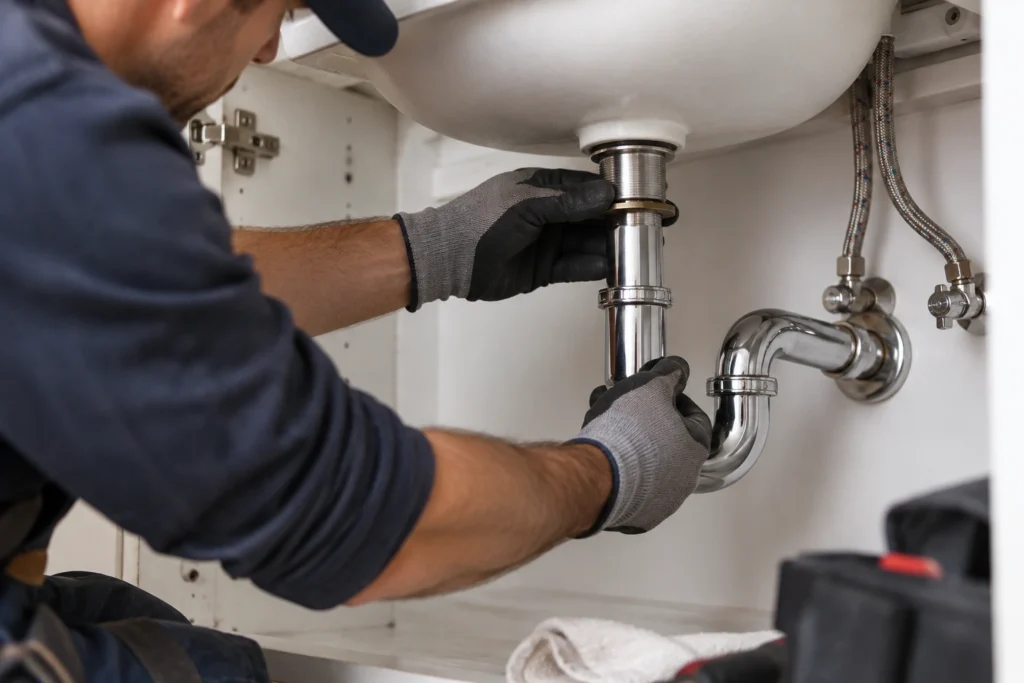
Conyers Plumbing Co provides professional plumbing services for homes and businesses, including drain cleaning, pipe repair, water heaters, fixture installation, sewer line repair, toilet repair, and emergency plumbing. Whether you need a quick repair or help with a larger plumbing problem, our team delivers dependable service focused on quality workmanship and lasting solutions.

Call Us Today
(470) 470-7151
24/7 Availability
Monday-Sunday
Homeowners usually start with a drip they can hear, a tank that is lukewarm, a shutoff they cannot find, or a warm streak on a slab floor. Those four map to the rest of the house, so we treat them as a whole-house visit rather than a single fixture job. We ask the decade of the house, whether it sits on a crawl or a slab, and whether the main shutoff already moved, because that short list tells us which tests to bring. Pressure, a quiet drain, and a humming disposal often ride along on the same call.
A whole-house call starts when the homeowner describes the symptom and the room that feels off, and we repeat it back so the first test matches that report. A technician walks the shutoff, the water heater, and the nearest fixture before any pipe is opened. Same-day diagnosis covers those tests on the first visit, then we explain what the readings ruled out. Repair follows only after the failed part or the camera view is visible, and we finish with a pressure check and a dry floor.
If water is running, move the house shutoff if you can find it, and stay clear of a wet slab or a live outlet. Photograph the area and note whether the floor is warm, which bath lost pressure, and whether the tank is making new noise. Skip drain chemicals and skip taking a disposal apart past the reset button, because that hides the clue we need. Have the decade of the house and the crawl or slab layout ready, since that changes which lines we open first.
After-hours plumbing services in Conyers follow the same test order as a daytime visit, and we take those calls any hour. A night leak still starts with the shutoff, the tank, and the room that is wet, then moves to repair once the source is clear. Night work does not skip the explanation, so the homeowner still sees what we found before a wall opens. If the issue can wait without damage, we say so and set a morning window so the house is not torn up in the dark.
Low pressure in these houses often starts at a galvanized run that has narrowed, a pressure reducing valve that has drifted, or a fixture cartridge packed with sediment. Rockdale Water Resources sends surface water from Big Haynes Creek, and even without a published hardness number, mineral film can slow an aerator while the main still looks fine. Shared meters on some lots and long upstairs runs make a shower starve when a washer fills. We measure static pressure at a hose bib, then compare it to the farthest bath.
In a two-story plan the washer and the upstairs shower often share a branch that was sized for one fixture at a time. When the washer solenoid opens, that branch cannot feed both, so the shower drops to a trickle. A weak PRV at the house makes the same scene worse because the whole system is already sitting low. We time the drop, check the PRV setting, and look at the washer box and the shower valve, which usually takes one visit.
A PRV, which is the valve that steps street pressure down for the house, should be tested when faucets hammer, when a toilet fill valve keeps running, or when a hot water heater T and P valve, which relieves pressure on the tank, drips at the discharge. Those signs mean the house side is seeing more pressure than the tank and the fixtures were built for. We gauge the street side and the house side, and the difference tells us whether the PRV is stuck open, stuck closed, or just worn. Replacement is a small valve job when the rest of the piping is sound.
Scale from city water can slow a faucet even when the main is wide open, and it is one of the quieter pressure complaints. Film builds on aerators, shower cartridges, and tankless heat exchangers while the line under the slab stays clear. We pull the aerator first, then the shower cartridge, because that short check often restores the spray without opening a wall. A slow kitchen tap with a clean aerator points us back to galvanized or a PRV, not more vinegar in the tap.
When a single fixture drains slowly and the rest of the house is fine, mechanical cleaning is the first step we take. Hair, grease, and soap in a kitchen or hall bath line often sit in a trap or a short run, and a cable or a jet clears that without digging. We only move to replacement when the camera shows a collapsed section, a heavy offset, or roots in a buried line. Kitchen and bath backups in the same week can still be a shared stack if the pipe wall is intact.
Snaking is the right tool when a localized clog sits in a trap or a short branch and the pipe wall is sound. Hydro jetting versus snaking becomes a real choice on longer kitchen lines with grease coating the wall, because a cable pokes a hole through grease and the coating grows back. A jet scours that film if the pipe can take the pressure, which we confirm with a camera first. Cast iron in pre-1980 stock can be too fragile for a heavy jet, so we stay with a careful cable there.
They often share a stack or a horizontal run in the slab or the crawl, so a clog downstream of both fixtures shows up in two rooms at once. In slab houses along West Avenue that shared run may sit under the hall, and a backup there can look like two separate clogs. We start at the cleanout, not at both traps, and we stop as soon as the camera shows the blockage. If the line is clear after cleaning, we check venting and the disposal discharge next.
The time to call for no hot water is when every tap runs cold, when the tank is wet at the base, or when the heater area smells wrong. Waiting overnight on a wet tank turns a repair into a floor job. A single faucet running cold while others stay hot is usually a mixing valve or a cartridge, and that can wait until morning if the rest of the house is dry. We check power or the fuel control, the T and P discharge, and the inlet valve first, which is a short sequence.
Rust at the base, water under the tank, popping that does not stop after a flush, and a T and P that weeps after the PRV is correct are signs the water heater needs replacement. A tank that still lights can still be finished if the glass lining is open and sediment has worn the steel. We measure incoming cold, outgoing hot, and the condition of the shell against those leaks, then we show the rust line. A repair of a valve or an element is still the first path when the tank shell is dry.
A tankless water heater heats on demand through a heat exchanger, so scale on the inlet screen and the exchanger matters more than a tank sediment layer. Error codes, a burst of cold in the shower, and a unit that fires then drops out are the usual calls. We flush the exchanger, clean the screen, and confirm fuel or electric supply before we talk about a new unit. Houses built since about 2000 with PEX and PVC often already have the venting path a tankless needs, while an older Milstead bungalow in Conyers may need that path built.
Summer in this part of Georgia means long indoor cooling and more shower and laundry cycles, and that load hits the tank every afternoon. A unit that barely kept up in cooler weather short-cycles when the family is home and the attic is hot. We check recovery, the dip tube, and the elements or burner, then we look at whether the T and P is wetting the pan. If the tank is undersized for the house, a repair will not add capacity, and that is the conversation we have before parts go in.
On a slab-on-grade house we start with a meter that should be still when every fixture is off, then we listen at the slab and scan for a warm path in the floor. Slab leak detection is that sequence, not a guess from a stain alone. We isolate branches so we know whether the leak is hot, cold, or a drain line, and we only open the slab once the path is marked. A warm hallway with a still meter is a different job than a wet carpet with a running meter.
Pipe repair is the right call when one failed section is reachable and the rest of the run still holds pressure. Repiping older homes becomes the conversation when galvanized in pre-1980 stock, about 37 percent of housing units in Conyers, keeps opening new pinholes after each patch. We show the thinned pipe, the pressure loss, and the number of recent breaks so the choice is visible. A crawl bungalow can often be repiped in sections, while a slab house may need a new overhead or reroute.
What to do for a burst pipe starts with the house shutoff and staying off a wet floor near outlets. Then open a faucet to relieve pressure in the broken run and move belongings off the wet zone. Skip a torch and skip a long clamp of hardware-store tape if the split is long, because that fails when pressure returns. Occasional hard freezes hit unheated garages, crawl spaces, and exterior-wall lines, and those are the burst locations we see.
Water line replacement is the better path when the leak is under a driveway, under a slab, or in a galvanized or polybutylene run that has already been patched. A short copper patch still makes sense on a reachable, otherwise sound copper line from the 1970s to 1990s stock. We pressure-test the isolated section and use the camera or the listening kit so the reason a patch would fail is visible. Polybutylene from 1978 to 1995, where it appears, does not take another clamp as a lasting repair.
How to fix a jammed garbage disposal at home stops at the reset button and a hex key in the bottom center, used with the power off. Keep hands out of the grind chamber, and skip chemicals that sit in the trap. If the unit hums and the hex key will not move, the grind ring or the motor is likely done, and that is garbage disposal repair rather than a reset. We kill power, confirm the dishwasher tailpiece is clear, and either free the jam or set a new unit.
Fixture installation in an older bath starts with shutoff valves that may not hold, supply lines that may be galvanized, and a drain that may be cast iron. We test those before the new faucet or toilet is set, because a fresh trim kit on a failing valve is a callback. Olde Town lots near Main Street often have original baths with tight access, so we plan the escutcheons and the shutoffs before we pull the old trim. Once the new fixture is on, we check for drip at the stops, the trap, and the supply.
If you smell gas or suspect a gas leak, go outside immediately and call 911 – this is a serious emergency that needs urgent attention from the gas company. Gas line repair at a range or water heater is a joint, valve, or short run job after that scene is safe, never a snug wrench on a live fitting. When the line is cold, we check the appliance valve, the drip leg, and the connector, then we leak-test the new joint. Gas line safety means that sequence, and we explain each step so the homeowner sees the valve that moved and the test that cleared it.
How fast an emergency plumber can arrive depends on the call load and where the house sits in Conyers, but the first minutes on the phone still cover the shutoff and whether water should stay off. We take the decade, slab or crawl, and a photo if one is available, then we head to the address with the parts that match that description. Night arrivals still begin with the same tests as daylight so a rushed patch does not hide a second leak. If the failure is a simple supply stop, the repair can finish on that visit.
When someone calls with a question before the visit, we check the shutoff status, whether the floor is wet or warm, and which fixture failed first. That short list decides whether the truck should come now or whether a morning window is safer. We also ask crawl or slab and the age of the hot water heater, because those two facts change which parts ride along. A question-only call still gets a clear next step, not a vague promise to look later.
Winter is the season that opens unheated garage lines and crawl runs, so burst questions cluster there. Summer is the season that cycles hot water heaters and fixtures as cooling and watering demand climb. Cecil sandy loam under slab-on-grade houses is well drained with moderate subsoil permeability, which still lets a slab leak travel before it shows at a finish floor. Those three stresses are why we treat the drip, the tank, and the slab as one house on the same visit.
A bungalow near the 1939 Rockdale County Courthouse on Main Street in Olde Town often still has galvanized supplies and a crawl shutoff that has not moved in years. Low pressure with a tank that is fine usually starts at that shutoff and the old steel, not at a new faucet. We test those first, then decide whether fixture installation can wait until the valves hold. That pattern matches the 1840s through 1940s housing in the historic district.
A West Avenue slab house from the 1960s onward more often reports a warm hallway and a meter that still turns with every fixture off. That is the pipe repair path for a slab leak, not a drain complaint. Copper and PVC from that era can still wear under the floor, and we mark the warm line before anyone saws concrete. The homeowner sees the meter test and the scan so the opening is only as wide as the leak.
Along Georgia Highway 138 toward the Georgia International Horse Park, houses from the 1990s onward with PVC and PEX usually call about a tankless water heater, a fixture drip, or garbage disposal repair. Galvanized is uncommon there, so we spend less time on steel and more time on vents, screens, and stops. If water is on the floor after dark, that becomes an after-hours plumbing visit with the shutoff first. The same test order still applies on that edge of town.
Conyers Plumbing Co is the crew that takes the drip, the tank, the hidden shutoff, and the slab house as one visit, and that is how we answer plumbing questions in Conyers. Water heater repair, drain cleaning, pipe repair, fixture work, garbage disposal repair, tankless service, water line replacement, and night leak calls all run through the same test-then-fix order. People looking for the best plumber for older homes, and people in later slab houses, get that same sequence from the first description to the last check. The goal is a dry floor and a clear explanation, not a pile of parts on the porch.
If a question is still open, how we work in Conyers shows the steps from the first description to the last pressure check. The Conyers plumber team also keeps a full list of plumbing services when the job is bigger than one fixture. We answer around the clock, we test before we cut, and we leave the room dry. Bring the decade, the slab or crawl, and the shutoff status, and the first visit will match the house you live in.
Reach out to us for assistance.
Service ZIPs: 30012, 30013, 30094
From clogged drains and leaking pipes to water heaters, sewer lines, and emergency plumbing, our team provides reliable plumbing service for homes and businesses.