
351 Gees Mill Business Pky N, Conyers, GA 30013
Available 24/7
351 Gees Mill Business Pky N, Conyers, GA 30013
Available 24/7
Emergency Plumbing
At Conyers Plumbing Co, we understand the panic and stress that comes with an unexpected pipe burst, a severe sewer backup, or a failing water heater. We are your dedicated emergency plumber in Conyers, available around the clock to restore order to your property. We do not want you to wait until morning when water is flooding your kitchen or sewage is backing up into your bathrooms. Our team is ready to respond with speed and precision.
When water is already in the hall of a slab house in Conyers, the next ten minutes decide how much of the house stays dry. Conyers Plumbing Co helps homeowners, townhome families, and condo residents when a line splits, a tank dumps, or a crawl run opens. We are the emergency plumber in Conyers, GA for burst pipe repair, a water heater emergency, a main water line leak, frozen pipe repair, overflowing toilets, and emergency leak repair. The same crew that already works these builder layouts contains the spray first, then traces the fitting that opened.
A night call from 30013 often starts as water at the baseboards on a post-1960s slab, or as a hiss in an Olde Town crawl bungalow. We work as a 24 hour plumber and a weekend plumber, and we stay available 24/7 from the first ring through the last check. Fixture drips, sewer backup, and sudden flooding sit in the same visit when the house is already wet. We test before we cut, and we leave the rooms as dry and orderly as the night allows.
Finding how to shut off water in an emergency still comes first, even when the main shutoff valve will not turn and we go to the meter. The notes below cover those first minutes, then the failures we repair in Conyers houses. After the water stops, we can plan a plumber that comes out the same day for a lasting joint.
From the first call to the final check, Conyers Plumbing Co keeps the plumbing service process simple, clear, and focused on solving the problem correctly.
Tell us what’s going on and choose a convenient time for your plumbing repair or service.
We inspect the issue, explain the recommended solution, and complete the necessary plumbing repair or installation.
We test the plumbing system, check our work, and make sure everything is operating properly before we finish.
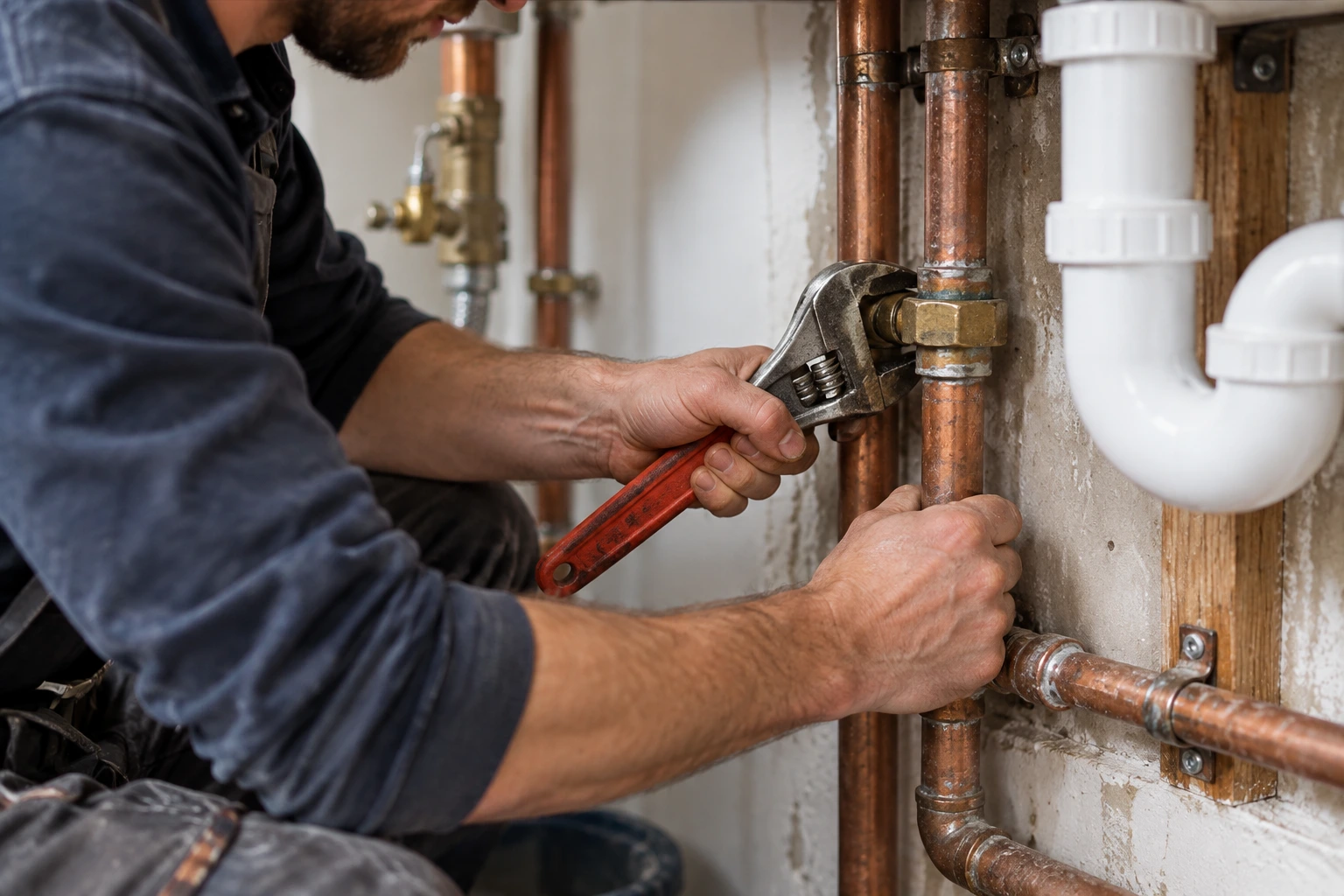
The interior main is the first handle we want turned, and it often sits in a garage wall box, a hall closet, or a pit that nobody has touched in years. Give that valve a steady try, not a hard jerk, because a brittle stem can snap and leave the leak worse. If it will not move, stop and go to the meter, where we can finish the isolation when we arrive. Ten minutes spent on that search saves a lot of drywall later.
Standing water around a hot water heater is both a flood and an electrical problem, so the closet gets a look from the dry side of the doorway. If you can reach the tank cold valve or the nearby switch without stepping in, shut those next. A gas control that sits in the same closet should be left alone if you smell fuel; get people outside and wait for the utility. We handle the tank once the room is safe to enter and the water is no longer climbing.
Keep off the wet slab until someone says the surface is safe, because live water on a smooth floor is a fall waiting to happen. Move rugs and small furniture only if you can do it from a dry edge. Kids, pets, and socks do not belong in that hall. Photos from a doorway help us bring the right coupling, cable, or tank kit, and they take less than a minute.
A short look around the house tells us whether the leak is a burst, a tank, or a backup, and it keeps you from making the wet zone larger. These checks are safe if the floor is stable and the air smells like water, not fuel. Skip anything that means opening a wall, cutting a pipe, or standing in sewage. The lists below are the ones we ask about on the first call.
Night bursts wreck floors fast in a Conyers slab house because there is no crawl to catch the spray. A split copper joint or a galvanized thread that lets go will fill a hall before anyone finds a valve. That is the work of an emergency plumber for a burst pipe at night, not a note left until morning.
We isolate the line, drop the pressure, and cut back to pipe that still has wall thickness. A coupling, a sweat joint, or a crimp is chosen to match the era of the pipe, and lasting pipe repair follows once the flood is stopped. On older Olde Town galvanized, we do not reuse a thin nipple that already crumbled in the wrench. About 37 percent of Conyers housing went in before 1980, so those threads still show up on night calls.
A dead shower is annoying. A tank that dumps into a closet is a flood, and that is who to call when the water heater floods rather than a wait until breakfast. Rockdale Water Resources draws surface water from Big Haynes Creek at Jack Turner Dam, and city water still leaves film on heating elements even though hardness is unpublished. Summer cooling and watering already cycle those tanks hard, so a lining that was thinning can open after a long day.
We shut supply, kill power or fuel, and drain enough water to stop the closet from filling. A fitting leak can take a nipple and a new valve the same night. A tank open at the bottom is isolated and set for replacement when we can roll a unit through without tearing wet drywall. If a tankless unit is flooding at a gasket, tankless water heaters work belongs in daylight after the leak is stopped. West Avenue houses from the interstate years often hide that tank in an interior closet with little overflow path.
Not every night flood is a dramatic split. Slow supply leaks still put water leaking through the ceiling onto beds and hall floors, and a pipe burst behind the wall can hide until the paint fails. In Conyers that often starts as a brown ring on plaster in an early 1900s Railroad Street house, or as a warm spot on a later drywall bay.
Moisture readings tell us whether the wet bay is still live before we open it. We stop the supply, open a small hole, and repair the joint we can see rather than peeling a whole room at midnight. Emergency leak repair on a ceiling is containment, a dry-down plan, and a solid coupling, not a full remodel on the first visit. Railroad Street lots of about 75 by 120 feet pack those baths over living rooms, so a small fitting can still rain on a sofa.
A fuel line at a hot water heater, range, or log lighter can fail in the same hour as a water leak, and those calls overlap in Conyers houses. If you smell gas or suspect a gas leak, go outside immediately and call 911 – this is a serious emergency that needs urgent attention from the gas company. We check connectors and valves only after the scene is safe. A wet closet does not get a wrench on a fuel control until that step is done.
Once the utility has cleared the odor, we pressure-test the appliance run and replace a failed connector or valve rather than leaving a soap-bubble patch. Houses along Georgia Highway 138 from the 1990s often have gas water heaters in interior closets, so a leak there is both air and water in a tight box. We do not relight anything until the reading is clean and the water side is isolated.
Sewage in a tub or shower is a health problem in a house, not a slow drain you can live with until Monday. What to do when sewage backs up in the tub is to stop every fixture so the stack is not still being fed. In Conyers we see this in Milstead mill bungalows with original cast iron and in later PVC when a main is blocked.
We open a cleanout, see whether the stop is close or out toward the tap, and cable or camera as the night allows. A mechanical clear can restore a bath before morning. Lasting drain cleaning with a camera belongs in daylight if roots or a belly remain. We do not run a disposal into a live backup, and we do not pretend a kitchen stop is the whole main.
A toilet overflowing and will not stop will put a bath floor under water in a few minutes, especially on a slab where there is nowhere for it to go. The angle stop at the wall is the first handle, and the main is next if that stop spins. This is shorter work than a burst main, but it still wrecks finish floors if it runs.
We shut water, clear the trap, and replace a fill valve that will not seat. If the china is cracked, a later fixture installation replaces the bowl after the floor dries. Houses toward the Georgia International Horse Park and Centennial Olympic Parkway from the 1990s often have PVC drains that overflow at the bowl, not the stack, so the night job may be the toilet alone.
Occasional hard freezes in north metro Georgia open unheated garages, crawl runs, and exterior-wall lines. Frozen pipe repair starts with stopping water, then finding the split, not with a torch on a still-iced joint. A frozen pipe burst in the crawl space is the pattern we see on pier-and-beam bungalows when a line sits against a cold skirt.
We thaw with safe heat, cut out the opened stick, and replace that run with pipe that can take the next cold night. Insulation or heat tape is part of the lasting fix on the same unheated bay. Mixed-era houses in Conyers can have a warm interior PEX addition feeding an older crawl copper, and the freeze almost always hits the older piece. We do not leave a clamp on a split that already lost its round.
When every fixture dies at once, the problem is rarely a single faucet. A main water line leak can wash a path beside a slab, drop pressure house-wide, and still look like a quiet yard until the meter spins. On many post-1960s slab houses along Interstate 20, the interior shutoff sits in a garage wall box that ices or rusts, so we go to the meter if that valve will not turn.
We confirm the leak with the meter and a pressure gauge on a hose bib, then isolate at the curb or a working valve. A broken interior main can take a coupling the same night if we can see it. A slab-line leak is contained, the wet hall is kept clear, and the reroute waits until we can work the slab without guessing. That garage-box-to-meter order is the check that belongs to these Conyers streets, not a generic first step.
The first decision on site is what we stop tonight versus what we finish after daylight. A burst in an accessible garage or crawl can take a coupling or a new stick of pipe once the water is off and the line is cut back to sound material. A hot water heater leaking from the bottom at night is isolated, drained enough to stop the flood, and set for replacement when we can roll a tank through the hall without tearing wet drywall. A slab leak under a finished hall is stopped at the meter or a manifold, and the lasting reroute waits until we can see the slab.
Containment means the main is off or the branch is capped, electricity is clear of standing water, and the T&P valve is not dumping into a ceiling. A temporary stop can be a cap, an isolation valve that saves one bath, or a joint we do not leave as the last word on thin galvanized. You will hear what still works before we leave. We do not pretend a clamp on crumbling steel is a repair, and we do not keep a live leak going so a kitchen can run.
Daylight work is for replacements that need a clear path, a dry slab, or a second person on a tank. If the break is in an exterior wall that froze, we open that bay when we can see, not when everyone is exhausted. Same-day diagnosis still happens on the first visit through pressure, a moisture meter, and a camera if a sewer backup is part of the night. The lasting joint, the new tank, or the reroute follows that map once the house is stable.
If sewage is in a tub, we stop fixture use, we mechanical-clean or camera as the night allows, and we do not run a cable blind through a cleanout we have not seen. Olde Town cast iron and later PVC both back up, but the feel at the cable is different, and forcing the wrong tool is how a night job becomes a wall job. We would rather leave a single working bath and return with the right head than guess in the dark. Conyers mixed-era additions make that patience worth it, because a 1990s PVC wing can sit on a much older stack.
When the ring comes in, we ask ZIP, the decade of the house, slab or crawl, whether the main is off, and a photo of the wet room. Those five facts take a few minutes and tell us whether to bring a tank, a cable, or a coupling kit. Conyers crawl bungalows need different drop cloths than slab halls. You will hear back with an arrival window, not a mystery wait.
The next open truck takes the call, and we stay on the road through nights and weekends because the water does not wait. Neighbors who already use our residential plumbing in Conyers still get the same isolation order on a night flood. Travel time across town is usually short once we know whether the house sits near Main Street or out toward the Horse Park. You will see one crew, not a handoff that makes you repeat the story.
Isolation often takes ten to twenty minutes, including the meter if the interior valve is frozen. Pressure, moisture, and a visual of the tank or the wet bay come next, usually another twenty to forty minutes. We explain what the readings rule out before we open a wall or cut a pipe. That is the same-day diagnosis on the first visit, and it keeps us from treating a slab leak like a closet fitting.
Accessible couplings can finish in under an hour once water is off. Tanks, slab reroutes, and long freeze replacements are staged for daylight after the flood is stopped. We pick up cuttings, bag wet debris, and leave a clear note of what still works. Floors get a dry path even when the lasting repair is not done that night.
Winter freezes in Conyers open garage boxes and crawl runs first, which is why night bursts cluster on unheated lines. Summer heat and watering cycle a hot water heater hard, so a tank that was already thinning can dump after a long cooling day. Cecil sandy loam under a slab does not behave like a high shrink-swell clay, but slab-line wear still shows up as a hall that stays wet after the visible pipe looks sound. Those three stresses are what we sort when we decide burst versus tank versus slab on the same street.
Isolation comes first, then we open only what we must to see the break. A pipe burst behind the wall often shows as a wet spot or a sagging ceiling while the supply is still live, so we kill water at the interior valve or the meter. Once pressure is down, we cut back to solid pipe and fit a repair that matches copper, PEX, or galvanized. If the wet bay is a shared townhome wall, we keep the opening as small as the joint allows.
When the water heater floods the closet, shut the tank cold supply and the nearby switch if you can reach them from dry floor. Conyers Plumbing Co treats that as a water heater emergency. We contain the closet, check the T&P valve, and see whether the leak is a fitting or a tank that opened at the bottom. A pan full of water at 2 a.m. is enough reason for a night visit because the rest of the hall is next. Replacement, if needed, often waits until we can roll a new unit without tearing wet drywall.
First we ask whether the main is off and whether anyone still hears spraying. In a Conyers slab house the hall wetness can be a burst, a tank that dumped, or a slab leak, so the first checks are the interior shutoff, the meter, and the water heater closet. We then use a moisture meter on the slab and a pressure reading on a hose bib to see if the leak is still live. Keep off the wet slab until we say it is safe. That order keeps us from opening a floor when the real break is a closet fitting.
A tank that weeps at a fitting can wait a few hours if the water is already off. A water heater leaking from the bottom at night usually means the glass lining failed and the closet will keep filling even at a trickle. Standing water near a fuel control or a breaker is the night risk, not the wait for daylight. We isolate, drain enough to stop the flood, and set the lasting replacement for when the path through the house is clear.
Stop flushing, stop the washing machine, and stay out of the water. What to do when sewage backs up in the tub is to cap the use of every drain so we are not pumping a live stack. In Conyers we see this in older cast iron and in later PVC when a main is blocked. We open a cleanout, camera or cable as the night allows, and we do not run a disposal. A mechanical clear can restore a bath the same night, with a follow-up if roots or a belly remain.
We kill water, then we look at the unheated run before we light anything. A frozen pipe burst in the crawl space is common on pier-and-beam bungalows in Conyers when a line sits against an exterior skirt. We cut out the split, replace that stick, and add insulation or heat where the same run would freeze again. No water after a freeze sometimes means the line is still iced, so we thaw with safe heat, never a torch. The repair is the split, not the ice alone.
Leave a seized valve alone so the stem does not snap. When the main shutoff valve will not turn, we go to the meter or a working isolation valve and stop the house from there. Many post-1960s Conyers slabs hide that interior valve in a garage box that ices or rusts. Once water is off, we can plan a new valve in daylight rather than force a brittle handle at midnight. Photograph the box from a dry spot if you can; that helps us bring the right key.
If the bowl is climbing, it will not wait. A toilet overflowing and will not stop is often a stuck fill valve or a blocked trap, and the bath floor can flood a slab house in minutes. Shut the angle stop at the wall, or shut the main if that stop spins. We clear the trap, replace a failed fill valve, and check the wax seal if water is coming from the base. Morning is fine only after the water is off and the floor is already dry.
Night work in Conyers is containment first, then the joint, tank, or cable that actually stops the house from getting wetter. Burst lines, hot water heaters, sewer backups, overflowing toilets, frozen runs, and main failures all sit with the same crew that already knows these shutoff spots. If the night stop is only a cap, scheduled pipe work is the right next visit, and a tank that survived until morning still belongs on water heater repair when the lining is thinning. Families who need more than the after-hours stop can use the rest of our plumbing services once the floors are dry. We keep the visit orderly from the first ring to the last pressure check, and we come back in daylight for the work that needs a clear path.
Reach out to us for assistance.
Service ZIPs: 30012, 30013, 30094
From clogged drains and leaking pipes to water heaters, sewer lines, and emergency plumbing, our team provides reliable plumbing service for homes and businesses.