
351 Gees Mill Business Pky N, Conyers, GA 30013
Available 24/7
351 Gees Mill Business Pky N, Conyers, GA 30013
Available 24/7
Water Heaters
Hot water is an essential part of modern living. From a warm shower in the morning to running the dishwasher after dinner, your water heater works silently in the background to provide comfort and sanitation. When this system fails, it is immediately noticeable and highly disruptive. At Conyers Plumbing Co, we specialize in comprehensive water heater repair and installation services. We are dedicated to ensuring that the residents and businesses of Conyers have reliable access to hot water year round.
When a garage tank is loud, rusty, or out of hot water by the third shower, Conyers Plumbing Co handles water heater repair in Conyers, GA for houses, townhomes, and condos. We restore heat for neighbors who still have to get kids to school and still have dishes in the sink. The same crew that already knows the builder layouts on these streets will look at the tank, the shutoff nobody can find, and the rest of the house in one visit. That is how a whole-house shop treats a cold morning, not as a single part on a bench.
Homeowners in 30013 call us for tank work along with pipe repair, fixture installation, drain cleaning, emergency plumbing, and garbage disposal repair, and we plan water heater installation when the old unit is done. We see closet tanks in Olde Town and garage tanks on later slabs, and we treat both as part of the same house. Testing comes before we open a supply, and we wipe the pan and reset the area before we leave.
A cold tank does not wait for weekday hours, so we answer 24/7. On the first visit we test the tank, the valves, and the power or fuel path, then we explain the shell, the elements or burner, and the supply in plain order. The next section walks through the first safe checks at the tank so you know what we will ask when we arrive.
From the first call to the final check, Conyers Plumbing Co keeps the plumbing service process simple, clear, and focused on solving the problem correctly.
Tell us what’s going on and choose a convenient time for your plumbing repair or service.
We inspect the issue, explain the recommended solution, and complete the necessary plumbing repair or installation.
We test the plumbing system, check our work, and make sure everything is operating properly before we finish.
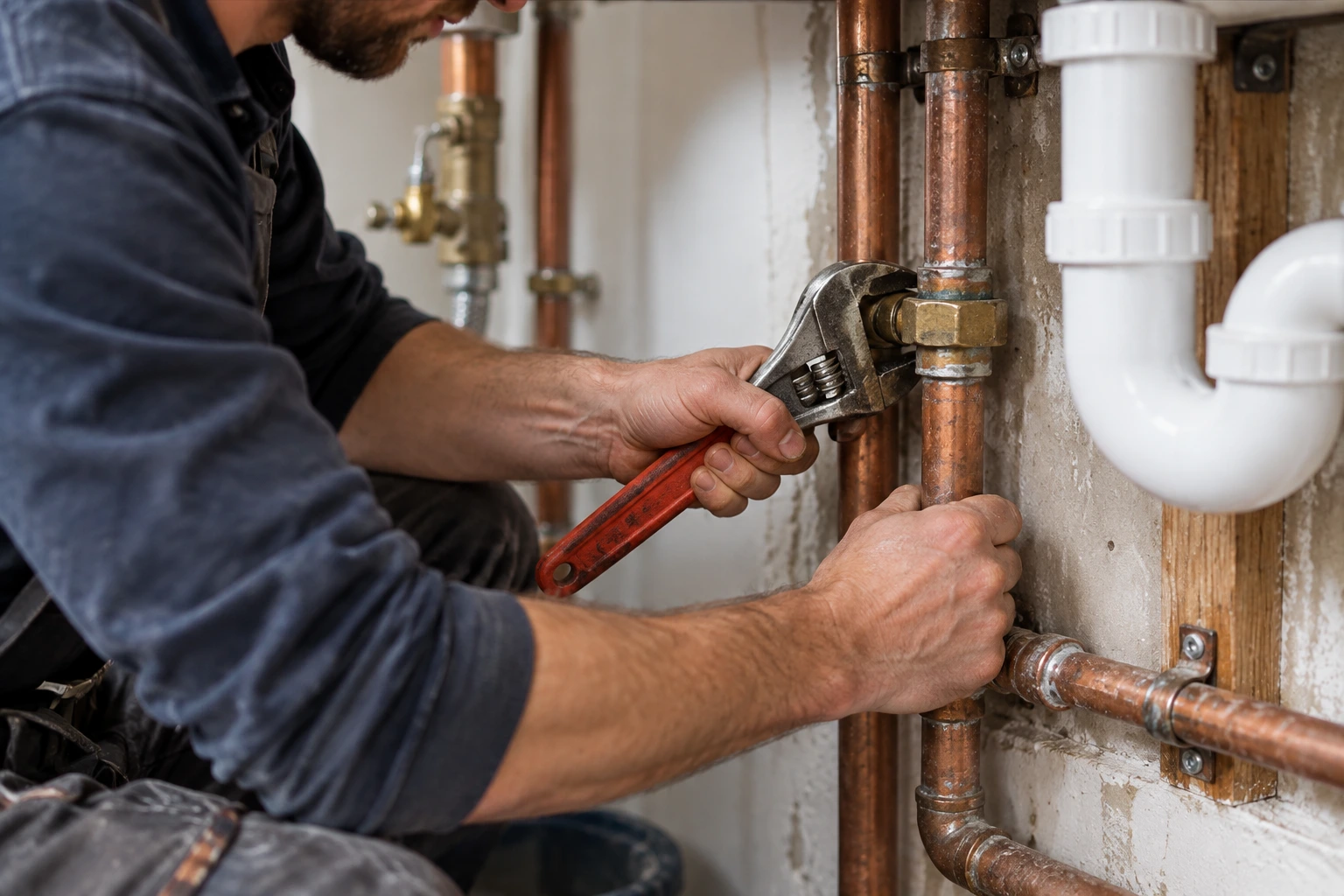
A cold shower is urgent in the house, and a leaking pan is urgent in a different way. We still start with the same order so nobody makes the tank worse while they wait. A few checks do not require tools, and anything that means taking the cabinet apart should wait. When we arrive we will ask what you already saw, so a slow look now helps the visit.
These looks tell us whether the problem is heat, water on the floor, or a tank that never started. Stay on dry flooring, and do not pull wires or the burner cover. Write down what each tap does, because that list shortens the first tests when we walk in.
A hot water heater under pressure can spray from a lifted valve, and a live electric water heater can shock if the panel is open. Sliding a full tank to see the back can kink the copper or PEX and open a second leak. Leave the cabinet closed unless water is already running across the slab and you need the shutoff.
Most calls start with no heat, a wet pan, rust at a tap, or a tank that sounds like it is boiling rocks. Those are different failures, and they show up in different rooms of the same house. We walk each one in the order below so the repair matches the part that actually failed.
A house that loses heat by the third shower stops the morning in a way a slow drain never does. Kids, guests, and a dishwasher all wait on the same tank. In Conyers that tank is often in a garage, so the later showers fail on a workday and everyone feels it. People sometimes try to fix no hot water fast by turning a thermostat dial, and that dial is only one small part of the system. We treat the loss of heat as a sequence of tests, not as a guess at the biggest tank we can roll in.
We start at power or fuel, then the thermostats, then the elements or the burner, because that order rules out a dead circuit before we drain anything. On an electric water heater we read both thermostats and both elements on the first visit. On a gas water heater we look at the control, the flame, and the vent draft. West Avenue garage tanks also lose recovery when the space around them is cold, so we note the room as well as the parts. If the parts can hold heat again, we repair them during that visit, and water heater repair the same day stays on the table when the shell is sound.
Water on a garage slab does not stay in a neat circle. It follows the slope to the door, soaks stored boxes, and can run along the floor edge of a slab house before anyone sees a puddle. A leaking water heater is messy in daily life because the pan overflows while people are still trying to shower. Top fittings, the drain valve, the T&P valve, which relieves pressure on the tank, and the shell itself all leak in different patterns. We sort that pattern before we talk about rolling the tank.
On post-1960s slab houses the cold supply often comes up through the slab into the garage, so we check the inlet nipple and that floor edge before we roll anything. A fitting leak can take a nipple, a valve, or a dielectric union. A seam leak or a rust hole in the shell is the end of that tank. We shut the supply, kill power or fuel, and keep the floor dry while we decide. That check is the unique part of tank work on Conyers slabs, because the leak can hide at the slab before the pan looks full.
A tankless water heater retrofit only fits some Conyers houses, and the limit is the vent path, the gas size, and the water quality we measure on site, not a brochure. Hardness is not published for this city water, so we do not sell a tankless unit on a guess about scale. If a tankless water heater is not heating, the heat exchanger, the vent, and the inlet screen are the first checks, and that work lives with our tankless water heaters visits. Closet tanks in Olde Town rarely have the vent run. Later houses toward the Georgia International Horse Park edge sometimes do.
Rusty hot water from the taps stains shirts, sinks, and tub enamel, and it makes people stop drinking from the kitchen tap even when the cold side looks fine. About 37 percent of housing units in Conyers were built before 1980, and those tanks and lines are the ones that shed rust. The tank anode can be gone while the galvanized lines in a Milstead bungalow are also old, so the color at the tap is not proof by itself. We separate those two sources before we pull a tank that did not cause the stain.
We run hot and cold separately, then we open the anode port when the shell still looks sound. Anode rod replacement can stop tank rust when the steel still has life. If both sides of the plumbing run rusty, the tank is not the whole story and the lines need their own look. Surface water from Big Haynes Creek at Jack Turner Dam supplies the city, and hardness is not published, so we do not blame a scale number we do not have. Color plus a thin shell is a replacement talk. Color plus a good shell is a parts talk.
A water heater making loud noises in a garage sounds worse than the same tank in a closet because the room acts like a drum. Popping, rumbling, and kettling usually mean sediment on the bottom that boils under an element or a burner. The noise is annoying, and it is also a sign the tank is working harder than it should to make the same heat. Summer cooling and watering already cycle the tank more, so the sound often shows up on hot afternoons when everyone wants a shower.
We drain a sample, feel the tank bottom, and listen with heat on so we know whether the sound is sediment, a failing element, or a loose dip tube. A water heater flush can quiet a sound tank. A thin bottom or a scorched burner chamber cannot. Garage tanks along later streets after Interstate 20 often sit on a pan with no one looking at them for years, so the first clue is the noise, not a drip. We tell you which of those we found before anyone talks about a new unit.
A gas water heater that will not hold a flame leaves the house with a cold tank and a smell of unburned fuel if the control is unhappy. The pilot light out on a workday morning is a common call, and a gas water heater pilot light will not stay lit when the thermocouple, the thermopile, or the draft at the hood is wrong. Burner dust, a weak valve, and a vent that will not pull also belong in that same visit. We treat flame problems as safety work first and comfort work second.
If you smell gas or suspect a gas leak, go outside immediately and call 911 – this is a serious emergency that needs urgent attention from the gas company.
We check the thermocouple, the burner, and the draft before we condemn the tank. A control valve that will not hold is a replacement part when the shell is good. A cabinet that has been scorched, or a vent that will not pull in a tight closet, changes that advice. Fuel work stays on the tank and the appliance valve. We do not leave a burner running if the draft is wrong, even if the water is already warming.
A dead tank is different from a tank that runs out. Nothing gets warm, the electric water heater is quiet, and the gas control never clicks. Reset buttons, tripped breakers, and a high limit that opened after a dry fire are the usual electric path. A water heater not working after someone drained it without killing power is also on that list. The house still needs heat the same day, so we keep the tests short and in order.
Thermostat replacement and heating element replacement cover a large share of electric failures when the shell is dry. We read ohms at both elements and we do not guess from the reset button alone. On fuel units we confirm supply at the valve, then the igniter or pilot path. Same-day diagnosis is the testing on that first visit, and we explain the reading before we open the supply. If the high limit opened because the tank ran dry, we also look for a leak that caused the dry fire.
A tank that takes all afternoon to recover makes the third shower a gamble. Sediment buildup insulates the bottom, so the burner or the lower element heats scale instead of water. Rockdale Water Resources draws surface water from Big Haynes Creek, and even without a published hardness number a tank still collects whatever settles over years. Summer demand then shows the weak recovery that winter hid.
We flush when the drain valve still works and the shell is sound. A seized drain valve or a tank that dumps rust by the cup is past a simple water heater flush. Houses along Georgia Highway 138 from the 1990s onward often have PVC or PEX supplies into a garage tank, which makes a clean swap easier if the tank is done. Older galvanized supplies need extra care at the nipples. Recovery problems that remain after a flush point to elements, a dip tube, or a tank that should come out.
The choice sits in four places: the shell, the nipples, the elements or burner, and the supply. Conyers Plumbing Co will say which of those failed while we are still in the garage or the closet, with the parts in view. Repair keeps a sound tank in service. Replacement is for a tank that will wet the slab again. When to replace versus repair a water heater is that conversation, not a feeling on the driveway.
A dry jacket, a firm bottom, and nipples that still have threads are a repair tank if the heat parts have failed. A wet seam, a rust hole, or a nipple that has eaten the tank steel is a replacement tank, even if the elements still read fine. Top leaks at unions can look like a tank failure and still be a fitting job. We dry the area, pressurize, and watch before we roll a unit that did not need to leave. On a slab, we also look at the inlet where the line rises through the floor, because that joint can drip while the shell is innocent.
Nipples on older tanks seize, and forcing them can twist the shell. When they will not come cleanly, replacement is kinder to the house than a cracked top. Closet tanks make that call slower because we have less room to work a wrench. Garage tanks give us room to see the top clearly. Either way, a wet shell ends the repair talk.
A burned element, a dead thermostat, or a dirty burner is a parts job when the tank still holds water. That is the usual path for water heater repair on electric and fuel units that simply stopped heating. Supply problems are different. A crushed inlet, a failed shutoff, or polybutylene on a 1978 to 1995 run can starve the tank or leak beside it. We do not replace an old water heater for a supply fault that a valve or a short pipe change would fix.
The best water heater for an older home is often still a tank that fits the closet, the pan, and the vent that is already there. A huge tank in a tiny closet overflows the pan and cooks the room. A tankless conversion needs vent and fuel we already covered. Water heater installation day in a garage is a roll, a set, and a tight discharge into the pan. The same install in a closet means floor protection, a tighter vent, and a longer carry through the living space. How long water heater replacement takes follows that room, not a single clock time. We walk the path with you before we drain the old unit so the house is ready.
Tank work fails when the crew treats the unit as an island. We keep the shutoff, the slab, and the rest of the house in the same visit because that is how these streets were built. The points below are the parts of the visit you can see.
Milstead bungalows hide tank shutoffs in crawls and behind stored boxes. Later West Avenue slabs put the valve in the garage where lawn tools bury it. We look in those spots first because we already work those layouts. Finding the valve before we cut a line keeps the house from taking extra water on the floor. That search is part of the job, not a delay.
We read thermostats and elements, lift a safe T&P only when the discharge is in place, and check the burner draft before we drain. Cutting first hides the evidence. Homeowners see the meter, the sample from the drain, and the wet or dry shell. Then we talk repair or replacement with those results in view.
The truck leaves from Gees Mill Business Pky N with elements, thermostats, anode rods, nipples, and pans for the tanks we see in these houses. A closet tank and a garage tank take different pans and discharge parts. Having those on the truck means the first visit can finish the repair when the shell is good. We still confirm the tag before we pull a boxed unit for a full swap.
The pan is wiped, the T&P discharge is routed, and the breaker or valve is labeled. We run hot water at a nearby tap until air clears and heat returns. Cardboard, old tanks, and wet rags leave with us. A closet job also means the door closes on a dry floor, not on a drip we meant to mop later.
The visit has a clear order so you can see each step. Times vary with garage versus closet and with repair versus replacement, and we say that up front. Nothing below is a mystery once we are in the house.
The visit starts with a short list: garage or closet, wet floor or dry, and whether any tap still has heat. The decade of the house helps because a pre-1980 Conyers house and a later slab house fail in different ways. A photo of the tag helps us bring the right elements. That keeps the first tests in order when we arrive.
We pick a window that matches how wet the floor is and whether the house has no heat at all. Night and weekend arrivals are part of how we work, not a special add-on. You will know who is coming and that we need clear space at the tank. If the pan is overflowing, we treat that as the first stop on the route.
Same-day diagnosis is the testing on that first visit. We show the shell, the nipples, the element or burner reading, and the supply. You will hear whether this is a parts repair, a tank swap, or a leak that is not the tank. Questions happen in the garage or closet, with the unit still in place, so the choice is tied to what you can see.
Parts go in with the power or fuel off. A replacement tank is set, leveled, and tied to the T&P discharge before we open the supply. We fill, bleed air, light or energize, and watch the pan. The last check is heat at a tap and a dry floor. Then we walk you past the shutoff so the next person in the house can find it.
Winter freezes hit unheated garages and crawl runs first, so a garage hot water heater can lose a drain valve or a T&P tail before the rest of the house knows. Summer heat and indoor cooling run the tank through more cycles, and that is when a tired element or a short recovery shows up. Cecil sandy loam around Conyers is well drained with moderate subsoil permeability, and on slab houses that soil still lets a leaking tank spread along the floor edge before anyone sees a puddle. We treat those three stresses as part of tank work, not as a separate lecture.
When the leak is on the copper or PEX supply and not at the tank shell, pipe repair is the right visit instead of a tank swap. When water is spreading across a garage slab at night, emergency plumbing is the right path so the house is not left wet until morning. When the house has a vent path and the load fits, tankless water heater work is the conversation after we confirm a tank is not the better fit.
A garage tank that serves three people often runs out because the dip tube, the elements, or the burner cannot keep up with back to back showers. In Conyers we see this on post-1960s slab houses where the tank sits in an unheated garage and recovery feels slower than a closet tank. We test incoming cold, thermostat settings, and the upper and lower elements or the burner before we talk about a larger tank. If the shell is sound, a heating element replacement or a thermostat replacement can restore the later showers. If the tank is tired, we walk through replacement during that same visit.
If the leak is at the top fittings, shut the tank valve if you can find it and keep people off the wet floor. Tape on the nipples or the pressure relief valve will not hold, and it hides the real source. On a Conyers slab the water can run to the garage door and look like a small drip while it soaks the floor edge. We isolate the supply, check the T&P valve, and see whether the leak is a fitting or the shell. A fitting we can often repair. A wet shell usually means we replace an old water heater while we are already in the garage.
Older Conyers houses, especially Milstead bungalows and other stock from before 1980, can send rusty hot water from the taps for two different reasons. The tank anode may be gone, or galvanized lines may be shedding rust on their own. We run hot and cold separately so we do not blame the tank for a pipe problem. An anode rod replacement can clear tank rust when the shell is still good. If both hot and cold come out rusty, the conversation moves toward the lines instead of another tank part.
When a tank is popping or rumbling, we start at the access panel and the drain valve, not at a pitch for a new unit. Loud noise is often sediment on the bottom of an electric or gas water heater that has not had a water heater flush in years. We feel the tank, drain a sample, and listen with the burner or elements on. In a Conyers garage the sound carries, so it can seem worse than the same tank in a closet. If the shell is thin, we talk replacement. If the shell is sound, a flush and a check of the anode may be enough.
How long water heater replacement takes depends on the room around the tank more than anything else. A garage tank with a clear pan, a nearby shutoff, and a vent we can reuse is a shorter swap than a closet tank with a tight door and a vent that has to be rebuilt. We shut power or fuel, drain, set the new tank, and check the T&P discharge and the connections before we leave. Closet jobs in older bungalows run longer because we protect floors and work in a smaller footprint. We tell you that order at the start of the visit so you can see each step.
Water heater repair for a condo is the same mechanical work with tighter access and a shared wall to respect. Closet tanks in condos often hide the shutoff behind the unit, which is why we ask about that shutoff before we slide anything. We still test elements, thermostats, and valves on the first visit. If the unit needs to come out, we plan the path through the living space and we leave the closet clean. Conyers condos and townhomes stay in our residential work, and we treat them as houses with less room to set a tank down.
When to replace versus repair a water heater on a slab house comes down to the shell, the nipples, and whether water has already reached the floor edge. A bad element or a bad thermostat is a repair. A leaking seam, a rusted nipple that has eaten the tank top, or a burner that has scorched the cabinet is a replacement. Slab houses along West Avenue hide water at the garage slab, so we look there before we decide. We explain that choice in the garage, with the parts in front of you, so the next step is clear.
Houses that can take a tankless water heater retrofit need a vent path, enough fuel if it is a gas unit, and water we measure on site rather than guess. Hardness is not published for city water here, so we do not promise a tankless unit on a scale story we cannot show. Some later houses have the space and the venting. Many older closets do not. If a tankless water heater is not heating, we still start with whether the house should keep a tank at all before anyone talks about a conversion.
A loud, rusty, or cold garage tank is still one piece of the house, and Conyers Plumbing Co keeps the shutoff, the supply, and the rest of the plumbing in the same visit. We repair elements, thermostats, valves, and burners when the shell can hold, and we handle water heater replacement and water heater installation when it cannot. Neighbors looking for a plumber in Conyers can start there, and the full list of plumbing services sits beside that tank work. We restore hot water for houses, townhomes, and condos in Conyers and we leave the pan dry.
Reach out to us for assistance.
Service ZIPs: 30012, 30013, 30094
From clogged drains and leaking pipes to water heaters, sewer lines, and emergency plumbing, our team provides reliable plumbing service for homes and businesses.